

Scientist
(Systemic analyses)
Polycrises
Polycrises cannot be understood in a linear way or through descriptive interpretive dominance, but rather through exploratory cause-and-effect modeling. I have created an as-yet-unpublished model on this topic, which reveals a remarkable number of interconnections.
Transformation, Welfare, Economy
For the German Environment Agency (UBA), we first used an Integrated Assessment Model to qualitatively explore how emotionally impactful actions and spillover effects could facilitate exponential transformation. Afterwards, in a quantitative simulation model with over 4,000 factors, we divided Germany into social milieus and ran scenarios for transformation, assessing the effects on the environment, climate, economy, welfare (NWI), and satisfaction.
Energy
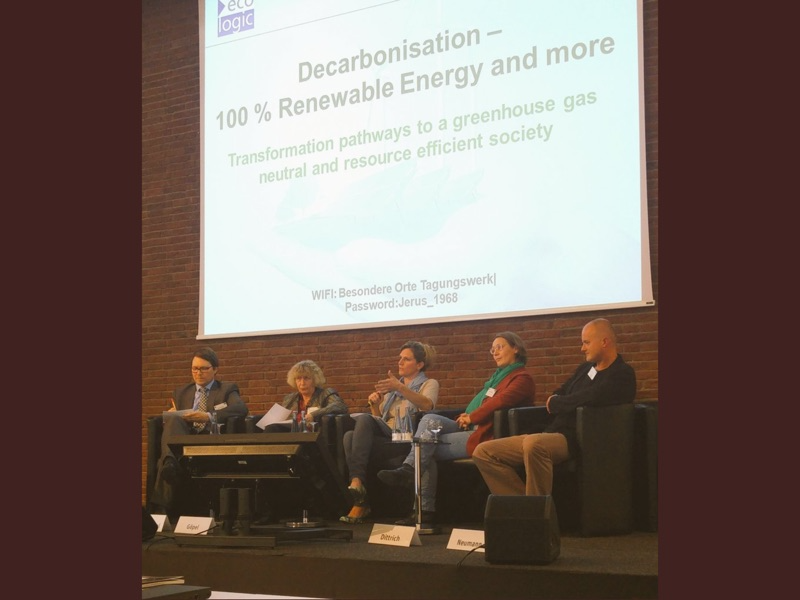
For the energy transition, I have developed several simulation models, including one for Germany which showed that, hypothetically, we could become completely self-sufficient, and one for the world (using WEO data), which turned most regions into economic winners. It would be feasible in any case, though with enormous implications for the supply of raw materials and the necessity of maximum electrification with underutilized electrolyzers (ToC).
Mobility
Among other things, I created a model for global battery-electric mobility for cars, trucks, buses, and short-haul airplanes and ships. The energy demand would be minimal, and current known lithium reserves would suffice. Hydrogen does not belong in the fuel tank.
Building Sector
In several projects, the focus was on energy demand in the building sector, as well as understanding the significance of reducing temperatures in hot water systems enabled by ultrafiltration techniques.
Raw Materials
The availability of critical raw materials was part of the energy transition models. These are fundamentally available, but in decreasing concentrations. This makes them more expensive, with implications for the circular economy and for countries that will only later enter the transformation. Of course, total human energy consumption also plays a decisive role, as do the geopolitical implications (see polycrises).
Artificial Intelligence
Again for the German Environment Agency, I collaborated with others on several projects addressing digitization and, through it, AI. The logical conclusions from the models—which also include softer factors—tend toward dystopian scenarios in the absence of societal restructuring. I have been working with AI in the narrower sense for over 30 years, ever since my university studies, and see potentials that do not necessarily need to be realized by me. I addressed this dissonance in my novels "The WHY of Life."
Nutrition, Agriculture, Forestry
Initially, the focus was on the potential to substitute steel and concrete with biotic raw materials, but FAO data on the development of forest and arable land, and on feeding the still-growing global population with its changing diet—taking into account intensive agriculture, organic agriculture, legumes, and much more—lead to rather pessimistic prospects. Several behaviors will need to change if we want to continue feeding the world.
Biomass Economy in Africa
Together with African stakeholders, we explored the potentials of a bioeconomy in Sub-Saharan Africa. Among the findings was the perhaps surprising realization that capital-intensive agriculture will not be of net benefit to the population. A more labor-intensive, locally organized cooperative bioeconomy that also improves soils could, however, be an alternative—from which, however, actors in industrial agriculture would benefit little.
Regime Change in an Authoritarian State
Together with experts from within Germany and abroad, we developed a scenario space for the overthrow of a government. One of several scenarios was a form of vision-driven, peaceful movement with secret support from the population, initiating change through guerrilla gardening and medical care that bypasses the corrupt structures of the country, serving as a starting point for a sweeping revolution.
SDGs
Possibly, I was one of the first scientist to to point to the fact that the SDGs are not only reinforcing in their interconnections but also balancing, in particular if we look at them from different country's perspectives. The model on know-why.net is only one example from a project in Ghana. It is worth to have a closer look not just on the international level but also on rather regional levels. Exploring this goes beyond the iSDG and other tools.
etc.
(Systemic analyses)
Polycrises
Polycrises cannot be understood in a linear way or through descriptive interpretive dominance, but rather through exploratory cause-and-effect modeling. I have created an as-yet-unpublished model on this topic, which reveals a remarkable number of interconnections.
Transformation, Welfare, Economy
For the German Environment Agency (UBA), we first used an Integrated Assessment Model to qualitatively explore how emotionally impactful actions and spillover effects could facilitate exponential transformation. Afterwards, in a quantitative simulation model with over 4,000 factors, we divided Germany into social milieus and ran scenarios for transformation, assessing the effects on the environment, climate, economy, welfare (NWI), and satisfaction.
Energy
For the energy transition, I have developed several simulation models, including one for Germany which showed that, hypothetically, we could become completely self-sufficient, and one for the world (using WEO data), which turned most regions into economic winners. It would be feasible in any case, though with enormous implications for the supply of raw materials and the necessity of maximum electrification with underutilized electrolyzers (ToC).
Mobility
Among other things, I created a model for global battery-electric mobility for cars, trucks, buses, and short-haul airplanes and ships. The energy demand would be minimal, and current known lithium reserves would suffice. Hydrogen does not belong in the fuel tank.
Building Sector
In several projects, the focus was on energy demand in the building sector, as well as understanding the significance of reducing temperatures in hot water systems enabled by ultrafiltration techniques.
Raw Materials
The availability of critical raw materials was part of the energy transition models. These are fundamentally available, but in decreasing concentrations. This makes them more expensive, with implications for the circular economy and for countries that will only later enter the transformation. Of course, total human energy consumption also plays a decisive role, as do the geopolitical implications (see polycrises).
Artificial Intelligence
Again for the German Environment Agency, I collaborated with others on several projects addressing digitization and, through it, AI. The logical conclusions from the models—which also include softer factors—tend toward dystopian scenarios in the absence of societal restructuring. I have been working with AI in the narrower sense for over 30 years, ever since my university studies, and see potentials that do not necessarily need to be realized by me. I addressed this dissonance in my novels "The WHY of Life."
Nutrition, Agriculture, Forestry
Initially, the focus was on the potential to substitute steel and concrete with biotic raw materials, but FAO data on the development of forest and arable land, and on feeding the still-growing global population with its changing diet—taking into account intensive agriculture, organic agriculture, legumes, and much more—lead to rather pessimistic prospects. Several behaviors will need to change if we want to continue feeding the world.
Biomass Economy in Africa
Together with African stakeholders, we explored the potentials of a bioeconomy in Sub-Saharan Africa. Among the findings was the perhaps surprising realization that capital-intensive agriculture will not be of net benefit to the population. A more labor-intensive, locally organized cooperative bioeconomy that also improves soils could, however, be an alternative—from which, however, actors in industrial agriculture would benefit little.
Regime Change in an Authoritarian State
Together with experts from within Germany and abroad, we developed a scenario space for the overthrow of a government. One of several scenarios was a form of vision-driven, peaceful movement with secret support from the population, initiating change through guerrilla gardening and medical care that bypasses the corrupt structures of the country, serving as a starting point for a sweeping revolution.
SDGs
Possibly, I was one of the first scientist to to point to the fact that the SDGs are not only reinforcing in their interconnections but also balancing, in particular if we look at them from different country's perspectives. The model on know-why.net is only one example from a project in Ghana. It is worth to have a closer look not just on the international level but also on rather regional levels. Exploring this goes beyond the iSDG and other tools.
etc.
Publications:
(see also https://www.consideo.de/papers.html)
Behrendt, S.; Henseling, C.; Sievi, M.; Lorenz, U.; Neumann, K.; Hilty, L. (2026): Rebound-Effekte durch digitale Leistungen und Produkte. TEXTE 75/2026, Umweltbundesamt https://doi.org/10.60810/openumwelt-8097
Grunewald, K.; Zieschank, R.; Förster J. (2026): Wertschätzung von Biodiversität – Zur Modernisierung der Wirtschaftsberichterstattung in Deutschland (Bio-Mo-D). Schlussbericht zum BMBF-Verbundprojekt, unter Mitarbeit von C. Beckmann, B. Hansjürgens, C. Henseling, S. Meier, K. Neumann, A. Korzhenevych, A. Sassalos, S. Schwarz, M. Sievi, T. M. Wildner. Zenodo.https://doi.org/10.5281/zenodo.19880131
Handlungsfeldanalyse (2025) Biodiversität und Wirtschaft (BioDiW) für die DBU zusammen mit IZT und dem Landschaftsforschungszentrum Dresden e.V. (https://www.dbu.de/projektbeispiele/handlungsfeldanalyse-biodiversitaet-und-wirtschaft/)
Neumann, K.; Sievi, M. (2024): Systemic Stakeholder Analysis - Background on the methodology and its application within the Bio-Mo-D project. DOI: 10.13140/RG.2.2.14674.57282
Grünwald, C.; Menninger, J.; Poole, S.; Glockner, H.; Weier, M.; Marbach, J.; Schipperges, M.; Neumann, K. (2024). Narrative einer erfolgreichen Transformation zu einem ressurcenschonenden und treibhausgasneutralen Deutschland. Umweltbundesamt, Texte 52/2024
Puls, N.J.; Neumann, K.; Zippel, S. (2024). Systemdynamische Modellierung komplexer hygienischer und energetischer Zusammenhänge im ULTRA-F-Forschungsprojekt. CAU Kiel. Anlage 15.10
Neumann, K.; Grimm, F. (2023): The GLU Model - Can we feed the world and survive it? DOI: 10.13140/RG.2.2.28568.16640
Neumann, K.; Hirschnitz-Gabers, M. (2022): Material efficiency and global pathways towards 100% renewable energy systems – system dynamics findings on potentials and constraints. in "JSDEWES.1123"
Neumann, K. (2021): Wrong memes: Organic farming and battery electric vehicles. In "Sustainable Development and Resource Productivity - the Nexus Approaches", Harry Lehmann (Hrsg.), Routledge, New York
Grünwald, C.; Glockner, H.; ....Neumann, K.; ....: Narrative einer erfolgreichen Transformation zu einem ressourcenschonenden und treibhausgasneutralen Deutschland. TEXTE 26/2021, Umweltbundesamt, Dessau
Diefenbacher, H.; Gechert, S.; Rietzler, K.; Gran, C.; Neumann, K.; Linsenmeier, M.; Oehlmann, M.; Zieschank, R. (2020): Analyse einer Integration von Umweltindikatoren und alternativen Wohlfahrsmaßen in ökonomische Modelle. Umweltbundesamt, Texte 189/2020
Hackfort, S.; Degel, M.; Göll, E.; Neumann, K. (2019): Die Zukunft im Blick: Technologie-Trends im Nexus von Ressourceneffizienz und Klimaschutz. Umweltbundesamt, Fachbroschüre
Neumann, K.; Grimm, F.; Diefenbacher, H.; Hirschnitz-Gabers, M.; Langsdorf, S.; Schipperges, M.; Weiss, D. (2018): Entwicklung eines quantitativen Modells "Nachhaltiges Deutschland". Umweltbundesamt, Texte 95/2018
Carl C. Anderson, Manfred Denich, Kai Neumann, Kwadwo Amankwah and Charles Tortoe
Identifying Biomass-Based Value Webs for Food Security in Sub-Saharan Africa: A Systems Modeling Approach
Sustainability 2019, 11, 2885, doi:10.3390/su11102885
Neumann, K.; Anderson, C.; Denich, M. (2018). Participatory, explorative, qualitative modeling: application of the iMODELER software to assess trade-offs among the SDGs. Economics: The Open-Access, Open-Assessment E-Journal, 12 (2018-25): 1–19. http://dx.doi.org/10.5018/economics-ejournal.ja.2018-25
Idealisiertes Systemdesign - neuartige, komplexe Projekte vorab reflektieren (Artikel im Projektmagazin, 2018)
Ursachen und Wirkungen in komplexen Projekten visualisieren und analysieren (Artikel im Projektmagazin, 2016)
Neumann, K.; Grimm, F.; Heinrichs, H. (2014): Entwicklung eines Integrated Assessment Modells: Nachhaltige Entwicklung in Deutschland. Umweltbundesamt, Texte 74/2014
Reflecting on Complex Challenges through Qualitative Modeling Using the IMODELER
(E:CO Issue Vol. 16 No. 2 2014)
KNOW WHY Thinking as a New Approach to Systems Thinking (E:CO Issue Vol. 15 No. 3 2013)
_______________
The grey series from Consideo
(each with models on KNOW-WHY.NET
and Franc Grimm as a co-author - download via
https://www.consideo.de/papers.html)
_______________
Teil 7: Bioeconomy - der intelligente Weg
Teil 6: Corona-Virus - eine systemische Sicht
Teil 5: Wie und warum Wandel möglich wäre
Teil 4: IKT - Utopie oder Dystopie?
Teil 3: Batterie-elektrische Mobilität - kein H2!
Teil 2: Kann ökologische Landwirtschaft alle ernähren?
Teil 1: Erneuerbare Energien - es ginge
_______________
Themen bezogene Anleitungen zur Modellentwicklung
zum Download unter
https://www.consideo.de/papers.html
_______________
A Business Culture of Reflection Part 5: Systemic Management and Organizational Development featuring the KNOW-WHY Method
A Business Culture of Reflection Part 3: Quantitative Optimization and Risk Analysis of Projects and Processes
A Business Culture of Reflection Part 1: Systemic Strategy Development and Risk Analysis (including Strategy Maps and SWOT Analysis)
_______________
Eigene Bücher:
_______________
KNOW-WHY and the iMODELER - Systems Thinking and Modeling for everyone
KNOW-WHY - Erfolg durch Begreifen
Wie und warum sich etwas ändern kann
KNOW-WHY and the iMODELER - Systems Thinking and Modeling for everyone
KNOW-WHY - Chancen für eine bessere Welt
KNOW-WHY - Wann Management erfolgreich ist
KNOW-WHY - Model Dein Glück
Modelst Du schon - oder tappst Du noch im Dunkeln?
__________________
Excerpt older paper / ebooks:
__________________
Six Sigma, Qualitäts- und Lean Management gemodelt
Management modelt (Change- und Krisenmanagement)
Systemische Strategieentwicklung
Das Beherrschen komplexer Projekte
Zukunft modelt - Vernetztes Denken ab dem Kindergarten
Know-Why statt Know How - Abbilden, erforschen, interpretieren - wie Unternehmen Wissen generieren und entwickeln können (mit Gautier Daecan ein Beitrag zur KnowTech 2007)
Intuitive Entscheidungsunterstützungsysteme (SEM Radar 2/2007)
Balanced Scorecard und Wissensbilanz
Multiprojektmanagement
Berherrschen von Komplexität in der Materialwirtschaft und Logistik (2011 in 'Materialwirtschaft auf einem Blick' von WEKA Medien GmbH & Co.KG)
Der langfristige Wertbeitrag eines ganzheitlichen Management-Trainings - eine dynamische Simulation (mit Thomas Klug für die Gesellschaft für Wirtschafts- und Sozialkybernetik, Band 26, 2011)
Accessing the Effectiveness of Policy Measures with the Help of Qualitative Modeling (mit Ullrich Lorenz, 2012)
Durch Modeln mentale Grenzen erweitern (in 'Wirkungsgefüge - Einsatzmöglichkeiten und Grenzen der Unternehmensführung', Hrsg. F.E.P. Wilms, 2012)
(see also https://www.consideo.de/papers.html)
Behrendt, S.; Henseling, C.; Sievi, M.; Lorenz, U.; Neumann, K.; Hilty, L. (2026): Rebound-Effekte durch digitale Leistungen und Produkte. TEXTE 75/2026, Umweltbundesamt https://doi.org/10.60810/openumwelt-8097
Grunewald, K.; Zieschank, R.; Förster J. (2026): Wertschätzung von Biodiversität – Zur Modernisierung der Wirtschaftsberichterstattung in Deutschland (Bio-Mo-D). Schlussbericht zum BMBF-Verbundprojekt, unter Mitarbeit von C. Beckmann, B. Hansjürgens, C. Henseling, S. Meier, K. Neumann, A. Korzhenevych, A. Sassalos, S. Schwarz, M. Sievi, T. M. Wildner. Zenodo.https://doi.org/10.5281/zenodo.19880131
Handlungsfeldanalyse (2025) Biodiversität und Wirtschaft (BioDiW) für die DBU zusammen mit IZT und dem Landschaftsforschungszentrum Dresden e.V. (https://www.dbu.de/projektbeispiele/handlungsfeldanalyse-biodiversitaet-und-wirtschaft/)
Neumann, K.; Sievi, M. (2024): Systemic Stakeholder Analysis - Background on the methodology and its application within the Bio-Mo-D project. DOI: 10.13140/RG.2.2.14674.57282
Grünwald, C.; Menninger, J.; Poole, S.; Glockner, H.; Weier, M.; Marbach, J.; Schipperges, M.; Neumann, K. (2024). Narrative einer erfolgreichen Transformation zu einem ressurcenschonenden und treibhausgasneutralen Deutschland. Umweltbundesamt, Texte 52/2024
Puls, N.J.; Neumann, K.; Zippel, S. (2024). Systemdynamische Modellierung komplexer hygienischer und energetischer Zusammenhänge im ULTRA-F-Forschungsprojekt. CAU Kiel. Anlage 15.10
Neumann, K.; Grimm, F. (2023): The GLU Model - Can we feed the world and survive it? DOI: 10.13140/RG.2.2.28568.16640
Neumann, K.; Hirschnitz-Gabers, M. (2022): Material efficiency and global pathways towards 100% renewable energy systems – system dynamics findings on potentials and constraints. in "JSDEWES.1123"
Neumann, K. (2021): Wrong memes: Organic farming and battery electric vehicles. In "Sustainable Development and Resource Productivity - the Nexus Approaches", Harry Lehmann (Hrsg.), Routledge, New York
Grünwald, C.; Glockner, H.; ....Neumann, K.; ....: Narrative einer erfolgreichen Transformation zu einem ressourcenschonenden und treibhausgasneutralen Deutschland. TEXTE 26/2021, Umweltbundesamt, Dessau
Diefenbacher, H.; Gechert, S.; Rietzler, K.; Gran, C.; Neumann, K.; Linsenmeier, M.; Oehlmann, M.; Zieschank, R. (2020): Analyse einer Integration von Umweltindikatoren und alternativen Wohlfahrsmaßen in ökonomische Modelle. Umweltbundesamt, Texte 189/2020
Hackfort, S.; Degel, M.; Göll, E.; Neumann, K. (2019): Die Zukunft im Blick: Technologie-Trends im Nexus von Ressourceneffizienz und Klimaschutz. Umweltbundesamt, Fachbroschüre
Neumann, K.; Grimm, F.; Diefenbacher, H.; Hirschnitz-Gabers, M.; Langsdorf, S.; Schipperges, M.; Weiss, D. (2018): Entwicklung eines quantitativen Modells "Nachhaltiges Deutschland". Umweltbundesamt, Texte 95/2018
Carl C. Anderson, Manfred Denich, Kai Neumann, Kwadwo Amankwah and Charles Tortoe
Identifying Biomass-Based Value Webs for Food Security in Sub-Saharan Africa: A Systems Modeling Approach
Sustainability 2019, 11, 2885, doi:10.3390/su11102885
Neumann, K.; Anderson, C.; Denich, M. (2018). Participatory, explorative, qualitative modeling: application of the iMODELER software to assess trade-offs among the SDGs. Economics: The Open-Access, Open-Assessment E-Journal, 12 (2018-25): 1–19. http://dx.doi.org/10.5018/economics-ejournal.ja.2018-25
Idealisiertes Systemdesign - neuartige, komplexe Projekte vorab reflektieren (Artikel im Projektmagazin, 2018)
Ursachen und Wirkungen in komplexen Projekten visualisieren und analysieren (Artikel im Projektmagazin, 2016)
Neumann, K.; Grimm, F.; Heinrichs, H. (2014): Entwicklung eines Integrated Assessment Modells: Nachhaltige Entwicklung in Deutschland. Umweltbundesamt, Texte 74/2014
Reflecting on Complex Challenges through Qualitative Modeling Using the IMODELER
(E:CO Issue Vol. 16 No. 2 2014)
KNOW WHY Thinking as a New Approach to Systems Thinking (E:CO Issue Vol. 15 No. 3 2013)
_______________
The grey series from Consideo
(each with models on KNOW-WHY.NET
and Franc Grimm as a co-author - download via
https://www.consideo.de/papers.html)
_______________
Teil 7: Bioeconomy - der intelligente Weg
Teil 6: Corona-Virus - eine systemische Sicht
Teil 5: Wie und warum Wandel möglich wäre
Teil 4: IKT - Utopie oder Dystopie?
Teil 3: Batterie-elektrische Mobilität - kein H2!
Teil 2: Kann ökologische Landwirtschaft alle ernähren?
Teil 1: Erneuerbare Energien - es ginge
_______________
Themen bezogene Anleitungen zur Modellentwicklung
zum Download unter
https://www.consideo.de/papers.html
_______________
A Business Culture of Reflection Part 5: Systemic Management and Organizational Development featuring the KNOW-WHY Method
A Business Culture of Reflection Part 3: Quantitative Optimization and Risk Analysis of Projects and Processes
A Business Culture of Reflection Part 1: Systemic Strategy Development and Risk Analysis (including Strategy Maps and SWOT Analysis)
_______________
Eigene Bücher:
_______________
KNOW-WHY and the iMODELER - Systems Thinking and Modeling for everyone
KNOW-WHY - Erfolg durch Begreifen
Wie und warum sich etwas ändern kann
KNOW-WHY and the iMODELER - Systems Thinking and Modeling for everyone
KNOW-WHY - Chancen für eine bessere Welt
KNOW-WHY - Wann Management erfolgreich ist
KNOW-WHY - Model Dein Glück
Modelst Du schon - oder tappst Du noch im Dunkeln?
__________________
Excerpt older paper / ebooks:
__________________
Six Sigma, Qualitäts- und Lean Management gemodelt
Management modelt (Change- und Krisenmanagement)
Systemische Strategieentwicklung
Das Beherrschen komplexer Projekte
Zukunft modelt - Vernetztes Denken ab dem Kindergarten
Know-Why statt Know How - Abbilden, erforschen, interpretieren - wie Unternehmen Wissen generieren und entwickeln können (mit Gautier Daecan ein Beitrag zur KnowTech 2007)
Intuitive Entscheidungsunterstützungsysteme (SEM Radar 2/2007)
Balanced Scorecard und Wissensbilanz
Multiprojektmanagement
Berherrschen von Komplexität in der Materialwirtschaft und Logistik (2011 in 'Materialwirtschaft auf einem Blick' von WEKA Medien GmbH & Co.KG)
Der langfristige Wertbeitrag eines ganzheitlichen Management-Trainings - eine dynamische Simulation (mit Thomas Klug für die Gesellschaft für Wirtschafts- und Sozialkybernetik, Band 26, 2011)
Accessing the Effectiveness of Policy Measures with the Help of Qualitative Modeling (mit Ullrich Lorenz, 2012)
Durch Modeln mentale Grenzen erweitern (in 'Wirkungsgefüge - Einsatzmöglichkeiten und Grenzen der Unternehmensführung', Hrsg. F.E.P. Wilms, 2012)