

Workshops
With 30 years of experience as a trainer in management topics, IT, soft skills, and of course systems thinking and modeling, I now only offer trainings on the KNOW-WHY-Thinking. It is an opportunity to consciously ask “why” in both professional and personal contexts, and thereby gain an understanding of the interconnections. This then becomes the foundation for taking effective steps—whether at work or in your private life.
With 30 years of experience as a trainer in management topics, IT, soft skills, and of course systems thinking and modeling, I now only offer trainings on the KNOW-WHY-Thinking. It is an opportunity to consciously ask “why” in both professional and personal contexts, and thereby gain an understanding of the interconnections. This then becomes the foundation for taking effective steps—whether at work or in your private life.
The open workshops remain accessible and easy to understand, even for participants who are less interested in companies or societal change. The workshops include numerous exercises and practical examples.
At the end of the workshop, participants receive a certificate as a "Practitioner of KNOW-WHY." Afterwards, participants can submit a specific topic, reflected upon using the KNOW-WHY method within a cause-and-effect model, and earn the title "Master of KNOW-WHY."
At the end of the workshop, participants receive a certificate as a "Practitioner of KNOW-WHY." Afterwards, participants can submit a specific topic, reflected upon using the KNOW-WHY method within a cause-and-effect model, and earn the title "Master of KNOW-WHY."
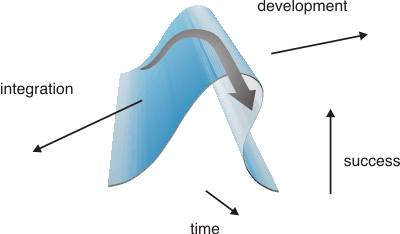
While the in-house workshops are tailored to the specific challenges of the company or organization, the open workshops focus on a mix of the following topics:
- Asking “WHY”
- The KNOW-WHY wave as a tool
- Awareness, rarely utilized
- The biopsychological drivers of human behavior
- The holistic integration and development plan
- Motivating people (when do NLP and similar methods work?)
- When are projects/teams successful?
- Systemic product development (idealized system design)
- Systemic corporate strategy
- The inherent dynamics of cultural development
- Potentials of societal transformation
- Dates for open workshops:
25.04.2026 Lübeck, Germany (Deutsch)
28.03.2026 Lagos, Portugal (English)
28.11.2026 Lübeck, Germany (Deutsch)
24.10.2026 Lagos, Portugal (English)
Registration and more info:
e
The bad news first: recognizing the interconnections can also make you unhappy!
According to the KNOW-WHY-Thinking, survival and evolution work by something adapting and continuing to develop in response to circumstances. If adaptation (integration) and further development are lacking over the long term, the existence of something is at risk. Many living beings have feelings or hormones that drive them to seek integration and further development, and they experience negative feelings when either is missing.
Interestingly, we can experience the same good or bad feelings in life through very different “things.” Doing something can feel just as good as having something or being something. For example, it can feel just as good to practice a bicycle kick in soccer as it does to buy a new pair of cheap jeans or to passively experience emotions with our favorite characters in an exciting movie. Whether something feels good depends largely on the dynamics of our social environment, which wonderfully explains, from a systemic perspective, how the world of consumption functions globally.
Against this background, global consumption, the remarkable gamification movement, the rise of artificial intelligence in everyday life, and so on, initially seem unproblematic. The real issues are the environment and the use of resources, along with global inequality and the resulting security risks, as well as the negative effects on health when we become increasingly passive. Additionally, passive experiences do not make us happy for long, whereas skills, achievements, and social relationships can make us happy for much longer. The only problem is that these are initially more demanding, and it’s almost like vicious or virtuous circles that lead to more and more passivity (eating, watching TV, playing computer games, shopping) or to active engagement, improved skills, and sociability.
We also have psychological defense mechanisms against active engagement that confirm our integration: what we have chosen is better than the alternative (cognitive dissonance), we can’t do the other thing anyway (learned helplessness), or we simply find it silly (psychological reactance).
Humans actually have an advantage over other living beings in that we can become aware of ourselves, envision ourselves in the future, and plan for it. “Actually,” because for many reasons we rarely do this and instead function wonderfully unconsciously, experiencing both joy and suffering.
With the KNOW-WHY-Thinking and a Holistic Integration and Development Plan (HIDP), we can now consider for ourselves and others what can give us feelings of development and integration, what prevents these, and what small, concrete steps we can take as a result. And we can try to do this in a way that fits our environment, financial means, skills, and health. Whether it actually feels good, we can only find out by trying.
According to the KNOW-WHY-Thinking, survival and evolution work by something adapting and continuing to develop in response to circumstances. If adaptation (integration) and further development are lacking over the long term, the existence of something is at risk. Many living beings have feelings or hormones that drive them to seek integration and further development, and they experience negative feelings when either is missing.
Interestingly, we can experience the same good or bad feelings in life through very different “things.” Doing something can feel just as good as having something or being something. For example, it can feel just as good to practice a bicycle kick in soccer as it does to buy a new pair of cheap jeans or to passively experience emotions with our favorite characters in an exciting movie. Whether something feels good depends largely on the dynamics of our social environment, which wonderfully explains, from a systemic perspective, how the world of consumption functions globally.
Against this background, global consumption, the remarkable gamification movement, the rise of artificial intelligence in everyday life, and so on, initially seem unproblematic. The real issues are the environment and the use of resources, along with global inequality and the resulting security risks, as well as the negative effects on health when we become increasingly passive. Additionally, passive experiences do not make us happy for long, whereas skills, achievements, and social relationships can make us happy for much longer. The only problem is that these are initially more demanding, and it’s almost like vicious or virtuous circles that lead to more and more passivity (eating, watching TV, playing computer games, shopping) or to active engagement, improved skills, and sociability.
We also have psychological defense mechanisms against active engagement that confirm our integration: what we have chosen is better than the alternative (cognitive dissonance), we can’t do the other thing anyway (learned helplessness), or we simply find it silly (psychological reactance).
Humans actually have an advantage over other living beings in that we can become aware of ourselves, envision ourselves in the future, and plan for it. “Actually,” because for many reasons we rarely do this and instead function wonderfully unconsciously, experiencing both joy and suffering.
With the KNOW-WHY-Thinking and a Holistic Integration and Development Plan (HIDP), we can now consider for ourselves and others what can give us feelings of development and integration, what prevents these, and what small, concrete steps we can take as a result. And we can try to do this in a way that fits our environment, financial means, skills, and health. Whether it actually feels good, we can only find out by trying.
Once we have internalized the KNOW-WHY-Thinking and look at systems in terms of their ability to develop further in an integrated way, it becomes remarkably simple to plan for the success of companies, projects, organizations, teams, and ultimately even products.
It goes so far that other concepts and philosophies can suddenly be understood in both their functioning and their potential failures. Vision, mission, strategy, and operational planning represent integration. Agility is the possibility for further development—too much of it, and integration is lacking. Effectuation, Holacracy, the Viable System Model, NLP in organizations—all of these only work to the extent that they enable the integrated development of the system and its people.
This applies to overarching systems such as the market, the company, the strategy, the team, the project, or the product, just as it does to the people—who are satisfied as employees or customers when they can experience integration and further development. It's astonishing how many people report being disengaged at work and how many products represent either too much development without enough integration, or too little development.
The application of the KNOW-WHY-Thinking within the method of Idealized System Design focuses on the development of superior solutions for products, teams, events, projects, buildings, etc. The iMODELER was created using this method, and the next features are already in the pipeline.
There is still one small catch: if you now want to bring the KNOW-WHY-Thinking into your organization, it will initially mean a lot of further development for everyone else. So, you need to consider how you can integrate this further development. Having said that, I'm sure we'll come up with something, right?
It goes so far that other concepts and philosophies can suddenly be understood in both their functioning and their potential failures. Vision, mission, strategy, and operational planning represent integration. Agility is the possibility for further development—too much of it, and integration is lacking. Effectuation, Holacracy, the Viable System Model, NLP in organizations—all of these only work to the extent that they enable the integrated development of the system and its people.
This applies to overarching systems such as the market, the company, the strategy, the team, the project, or the product, just as it does to the people—who are satisfied as employees or customers when they can experience integration and further development. It's astonishing how many people report being disengaged at work and how many products represent either too much development without enough integration, or too little development.
The application of the KNOW-WHY-Thinking within the method of Idealized System Design focuses on the development of superior solutions for products, teams, events, projects, buildings, etc. The iMODELER was created using this method, and the next features are already in the pipeline.
There is still one small catch: if you now want to bring the KNOW-WHY-Thinking into your organization, it will initially mean a lot of further development for everyone else. So, you need to consider how you can integrate this further development. Having said that, I'm sure we'll come up with something, right?
Consideo, iMODELER
Privat
info@ilsa.de
(c) 2026